Nature Notes: A Maine Naturalist Afield
Host: Logan Parker
Producer: Glen Mittelhauser
In this episode, Logan introduces listeners to the robber flies—voracious predatory insects with names like “marauder,” “bandit,” and “thief”—and describes their surprising diversity in Maine, from garden-perching hammertails to the formidable marauders of the pine barrens. He also highlights their ecological value, noting how these agile hunters help keep insect populations in balance despite their fearsome reputation.
Transcript
Imagine this: a typical New England vegetable garden on a sunny summer’s day. A handful of pumpkins laze along the ground and bean plants snake their way up poles leaned together. Tomatoes hang heavy with fruit while some cosmos and calendula sway in a gentle breeze. Such a scene is not likely to conjure up thoughts of danger or mortal peril. And yet, even this idyllic landscape is rife with predators. Like highwaymen haunting the roads leading into 17th century London, a myriad of assailants lay in wait along the garden paths ready to waylay passersby. While the gardener’s left to pass in peace, the same can not be said of some flower-bound hoverfly, beetle, or greenbottle. Armed with a blade-like implement, this brigand has come to rob them of their lives.
So who is the culprit? The aptly named Robber Fly. With common names often including titles such as “marauder”, “bandit”, and “thief”, the propensity for violence among this family within the order of Diptera is well established. While many true flies are rather benign scavengers and nectar sippers, robber flies are consummate predators. In place of straw-like or spongy mouth parts, these flies make use of a short dagger-like proboscis and a subsequent neurotoxins injection to subdue their prey. The long, blade-like ovipositors borne by many species are used for egg laying rather than playing any sort role in the species’ more barbarous acts.
Within the gardens, door yards, and forest edges of New England, the Northeastern Hammertail (Efferia aestuans) is the most common species. I have frequently encountered this species perched atop a bean pole, garden stake, or tomato cage. Of the local robber flies, this species appears to be the most willing to land on humans; though they do so seemingly only to make use of suitable vantage or resting place and with no intent to cause harm. While robber flies are capable of delivering a bite to a human, they seldom do so and seem only to do so in their defense. In addition to the Northeastern Hammertail, Micropanthers, small robber flies belonging to the genus Atomosia as well as the Stripe-legged Robber Fly (Dioctria hyalipennis), which was introduced to the United States in the early 20th century, are also relatively common near human habitation.
Having spent much of the last few summers working within Maine’s scattered pine barrens I’ve had regular encounters with another genus of robber flies commonly known as the marauders. Both the Northeastern and Eastern Red-tailed Marauders (Proctacanthus philadelphicus and Proctacanthus rufus respectively) can be found patrolling the boundaries of the scrub lands or buzzing above expanses of exposed sand. The marauders are large, conspicuous individuals capable of tackling prey including butterflies and dragonflies as well as other well-armed insects such as yellowjackets, hornets, and even other smaller robber flies.
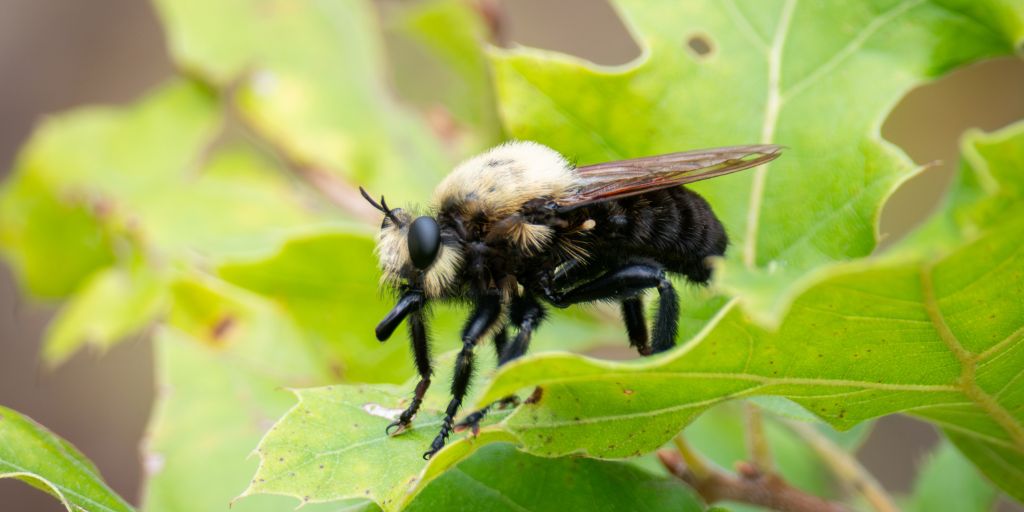
After emerging from a tangle of scrub oaks one afternoon, I spotted what looked like a very large bumblebee perched on the forage of a small tree within the clearing. On closer inspection, I spotted this individual’s short antennae, large eyes, and impressive proboscis. Here was Laphria grossa, a robber fly belonging to the genus Laphria, a band of robber flies which mostly don the guise of bumblebees to lower the guard of unsuspecting beetles. As I watched, this individual craned its head about, no doubt eying some passing prey before darting off with an audible buzz.
Striking a contrast to the rather bulky Giant Laphria is the delicate Shellac-backed Pixie (Tipulogaster glabrata). While some robber flies will take mobile prey, whether on the ground or in the air, this pixie ambushes perched insects. Beautifully streamlined, this species has a long, slender form, six crane-like legs, and a head composed of little more than a large set of eyes and short but deadly proboscis.
For all their villainous names and associations, robber flies serve important roles on the landscape. Their predatory habits help keep insect populations in balance, ensuring that our gardens and meadow lands hum rather than swarm with insect life. They have even been known to help keep invasive species in check. A study of Chilean robber flies found that the insects were the primary hunters of invasive bee species in the region (Barahona-Segovia and Pañinao-Monsálvez, 2020). So when you catch sight of a robber fly resting on a stake or sunning on the sand, take a moment to admire this skyborne “bandit” or “marauder” who, in truth, is just as much a keeper of the peace.
Related Episodes
-

12/8/24: Seasonal Shift
The transition from summer to autumn ushers in more than just magnificent foliage. Join Logan on a stroll through…
-
1/19/25: Hollies of Maine
Hollies have long been associated with winter celebrations, both “across the pond” and here at home. Here we introduce…
-
1/26/25: Late Autumn Sulphurs
Late autumn isn’t usually a time associated with butterflies, yet a few hardy species persist despite chill and frost.