Monitor a Nest Box on your property!
Each spring, Maine experiences an influx of hundreds of migratory breeding birds, many of whom utilize cavities for nesting sites. Our state, with its rich mosaic of different habitat types, provides suitable breeding grounds for a variety of cavity-nesting species ranging from songbirds to raptors to waterfowl. Cavities include naturally occurring sites such as the chambers drilled out by woodpeckers or hollows formed in trees after a branch breaks. Suitable sites also include man-made nest boxes designed to meet the requirements of a specific species when installed in appropriate habitat. These nest boxes present a unique opportunity for observers to gather detailed information about the breeding status of these birds while providing nesting opportunities where sites may be limited.
Although many cavity-nesting species are currently increasing in number, some species, such as the American Kestrel, Tree Swallow, and Purple Martin, are experiencing declines in Maine. Habitat destruction and competition from invasive species like the European Starling and House Sparrow for suitable nest sites pose threats to cavity-nesting species. All the while, climate change threatens to exacerbate this issue of nest cavity competition by favoring the aggressive invasive species, which remain on or near their breeding grounds year-round, while disadvantaging non-resident individuals that migrate to reach their breeding grounds.
Use the links below for guidance on constructing and monitoring a nest box on your property. We occasionally have pre-built nest boxes available for volunteers on a first-come, first-served basis. Contact Logan Parker (logan@mainenaturalhistory.org) for more information.

Stay Connected
Follow the progress of this project through our newsletter or on social media
Nest Monitoring Projects
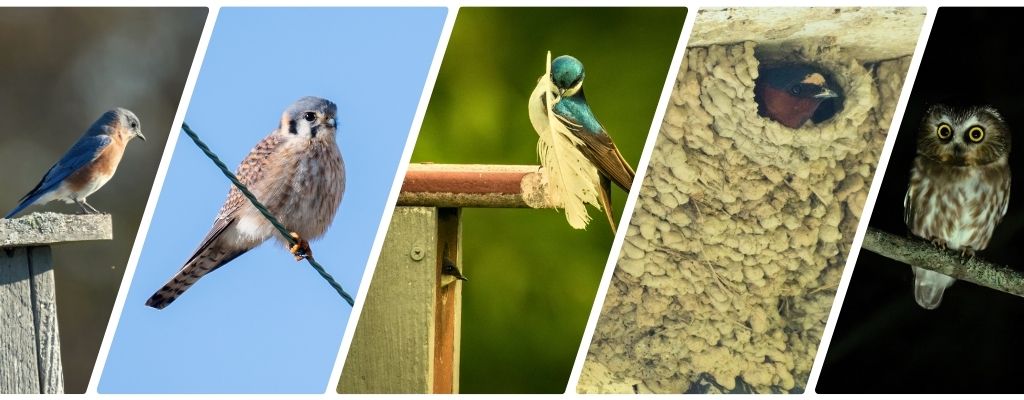
MNHO is currently collaborating on nest monitoring projects for the following three species: American Kestrel, Tree Swallow, and Cliff Swallow.
The American Kestrel, once known as the Sparrow Hawk, is the smallest falcon in North America and a swift predator. It is mostly associated with open habitats such as grasslands, meadows, powerline right-of-ways, and agricultural landscapes. American Kestrels are a cavity-nesting species. They do not, however, excavate or modify nesting cavities like woodpeckers, chickadees, or nuthatches. They instead usually rely upon the abandoned nest sites of woodpeckers.
Midcoast Kestrel Project
MNHO is collaborating with the Maine Department of Inland Fisheries and Wildlife (MDIFW) and Mid-Coast Audubon to expand the Midcoast Kestrel Project.
Volunteer Resources
MNHO and our partners are seeking volunteers to help report kestrel breeding observations throughout the state to guide future project initiatives. More details on these efforts and how to submit observations will be available soon.
Stay tuned!
Although this species is most associated with open country (where they forage), Tree Swallows historically relied exclusively on trees for their nesting sites. While this species continues to use the nesting cavities created by woodpeckers as secondary cavity nesters, nest boxes put out by people now play a large role in the species’ breeding activities. Marshes, grasslands, and agricultural lands with suitable nesting sites nearby all provide breeding habitat for this species.
Tree Swallow Nest Box Monitoring Project
MNHO is collaborating with the Maine Department of Inland Fisheries and Wildlife (MDIFW) to field test a modified nest box design to mitigate heat and reduce nesting failure due to extreme weather.
Volunteer Resources
MNHO is not accepting volunteers for Tree Swallow nest box monitoring at this time.
Learn more.
Although this species historically nested on the cliffs and ledges of the Rockies and Sierra Nevadas, they have spread throughout North America. Cliff Swallows are highly gregarious and nest in close proximity to one another — sometimes by the hundreds or even thousands. Because Cliff Swallows rely on a regular supply of mud to maintain their nests, colonies are typically formed near wet areas where mud is plentiful (though these birds will fly longer distances to gather particularly suitable material).
Cliff Swallow Colony Monitoring Project
MNHO is collaborating with the Maine Department of Inland Fisheries and Wildlife (MDIFW) to help understand Cliff Swallow breeding distribution in Maine and increase the number of nesting options for this remarkable species.
Other Species
MNHO is collecting preliminary data on Eastern Bluebirds and Northern Saw-whet Owls, and you can help!
In the handbooks below, there are plans for simple nest boxes that can be built by anyone with rudimentary carpentry skills and can be modified to suit the wood you have available. Be aware that your nest boxes may initially be ignored. Give the birds some time to find your box before considering moving it to a new location.
Monitoring on your property will help gather valuable information about the status of Maine’s cavity-nesting birds, confirm breeding for elusive species (such as owls), and increase the availability of suitable nesting sites for these native species. Thank you!
While this species is known to use the nesting cavities created by woodpeckers as nest sites, artificial nest boxes put out by people now play a large role in the species’ breeding success. This species, which is most associated with open country, often nests in close proximity to human activity. Farms, orchards, pastures, and other agricultural lands all provide suitable breeding grounds for this charismatic species.
The Northern Saw-whet Owl is one of the smallest owls in North America. Coniferous, deciduous, and mixed forests are regularly inhabited as well as coastal shrublands and even more open habitats such as shrubby powerline right-of-ways, so long as there is suitable nesting and hunting habitat. Northern Saw-whet Owls are a cavity nesting species. They do not, however, excavate or modify nesting cavities like woodpeckers, chickadees, or nuthatches. They instead rely upon the abandoned nest sites of woodpeckers, principally Northern Flicker and Pileated Woodpeckers. They prefer nest sites ranging from 10’ to 15’ in height that are within or on the border of forested areas.
Related Content
-

Purple Sandpiper Surveys
Repeating Historical Purple Sandpiper Surveys to Update Status of Overwintering Population In the early 2000s, Glen Mittelhauser and collaborators…
-
Riparian Swallow Surveys
MNHO is excited to announce the launch of a new research project: the Maine Riparian Swallow Survey. The primary…
-
Harlequin Ducks in Jericho Bay
In the 1990s, research indicated that Jericho Bay was the single largest wintering location for Harlequin Ducks in Eastern…