
In his 1949 book, Maine Birds, biologist Ralph S. Palmer described the American Kestrel— then called the “Northern Sparrow Hawk”—as “common throughout” the state and “the second hawk in [terms] of numbers.” While kestrels can still be spotted on power lines and snags in open areas across Maine today, their numbers have declined in recent decades.
The results of Maine’s second Breeding Bird Atlas (2018–2022) suggest that kestrels have retracted from parts of southern Maine, including coastal sections of the Midcoast Region.
The causes behind the decline of kestrels in Maine are not fully understood but likely include habitat loss, pesticide exposure, increased predation, and competition for nesting sites. As secondary cavity nesters, kestrels rely on natural tree cavities or those excavated by woodpeckers, but they readily use nest boxes. These boxes not only support kestrel populations, but also allow researchers to monitor breeding behavior more easily.
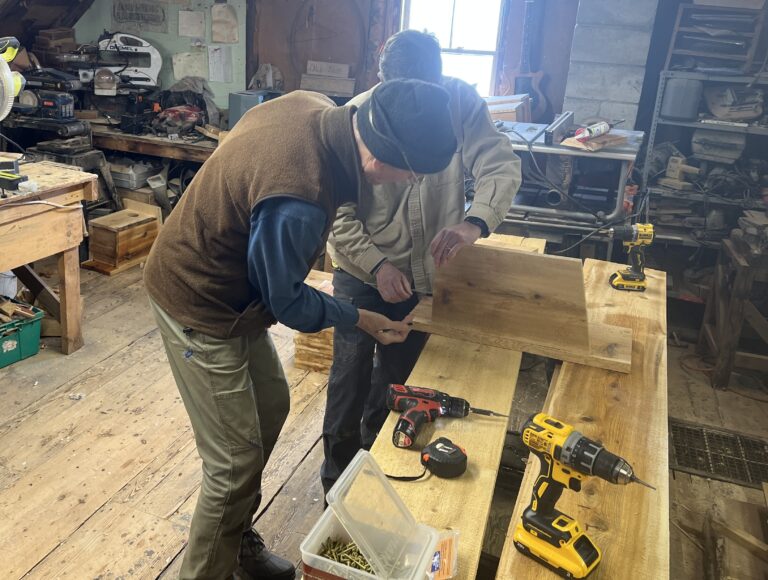
In response to population declines, the Maine Natural History Observatory (MNHO), in partnership with the Maine Department of Inland Fisheries and Wildlife (MDIFW), is expanding our kestrel nest box monitoring efforts as part of the Maine Kestrel Project. Working in collaboration with Mid-Coast Audubon, MNHO has launched an expanded monitoring effort focused on the Midcoast region. Expanding nest box efforts will benefit kestrels by increasing available nesting sites and providing researchers with valuable information about breeding success. These insights will help shape future management and conservation actions for Maine’s kestrel populations. With dedicated effort and community support, we hope to slow or even reverse the downward trend of kestrels in the Midcoast.

Volunteer Resources
Want to contribute to this project? MNHO and our partners are seeking volunteers to help report kestrel breeding observations throughout the state to guide future project initiatives. More details on these efforts and how to submit observations will be available soon. Stay tuned!

Join the Project
Report Kestrel breeding observations throughout the state!
Time/Skill Required
No set time commitment.
Identify American Kestrels displaying breeding behavior.
Submit your observations to the MDIFW portal. Details coming soon.
Project Collaborators


Project Supporters
This project is made possible by our nest box sponsors and the many
landowners and property managers who allow us to
deploy and monitor nest boxes on their properties.
Thank you!
Latest
Project Updates
-
Midcoast Kestrel Project Takes Flight!
13 April 2026
Stay Connected
Follow the progress of this project through our newsletter or on social media
Related Content
-

Cliff Swallow Colony Monitoring
Recent information suggests that Cliff Swallows are decreasing in Maine. Consequently, Cliff Swallows are listed as Species of Greatest…
-
Tree Swallow Nest Boxes
Like many other aerial insectivorous birds, Tree Swallows are declining throughout their northeastern breeding range. While still widespread in…