Nature Notes: A Maine Naturalist Afield

Host: Logan Parker
Producer: Glen Mittelhauser
In this episode, Logan explores the plant communities of Maine’s pitch pine–scrub oak barrens, from fire-adapted pines and dense thickets of scrub oak to rare wildflowers, grasses, and sandplain specialists. He highlights the insects and butterflies that depend on these habitats, including several rare species, and the management efforts that help maintain these declining ecosystems.
Transcript
Contrary to what their title might imply, pine barrens are not lacking for flora and fauna. In fact, most vegetated areas are so densely populated by plants that they can be quite difficult to traverse.
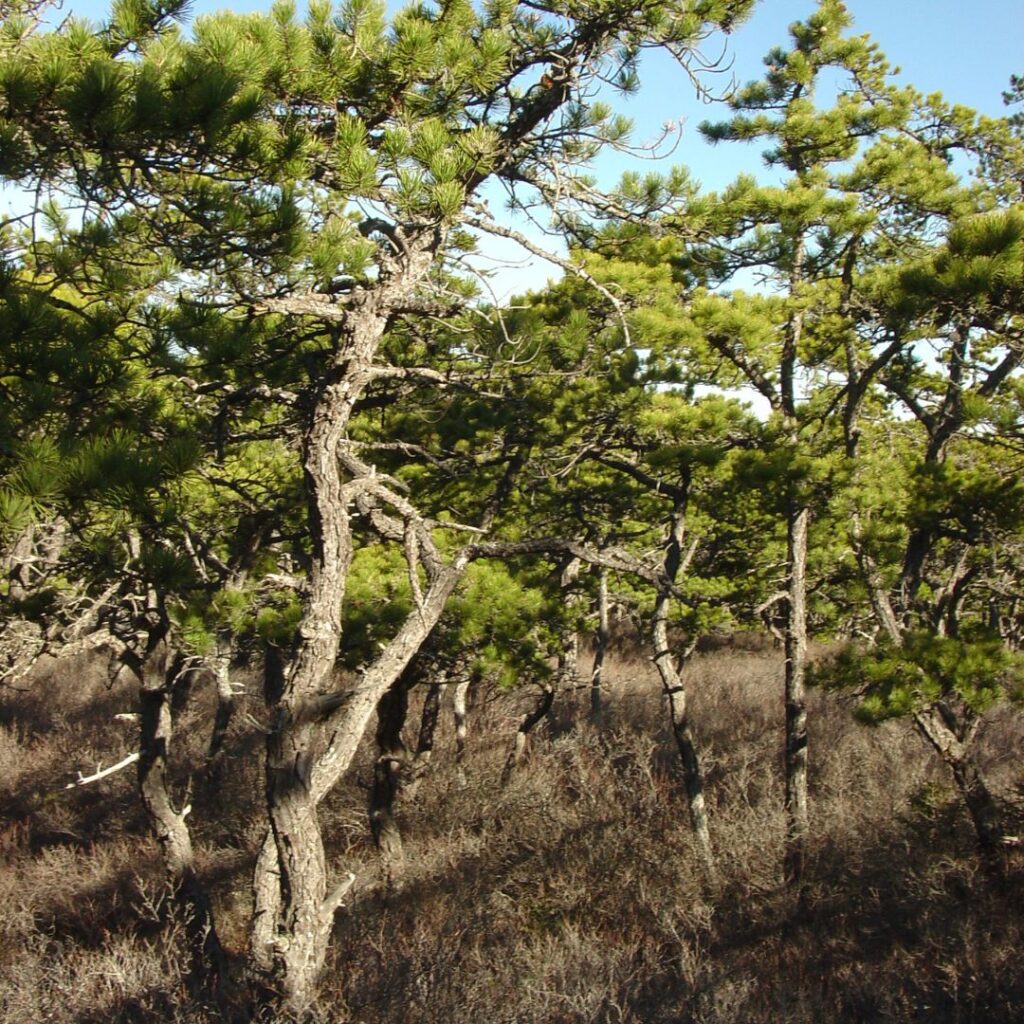
As would be expected, pines are significant members of the barren’s plant community with Pitch pine (Pinus rigida) serving as the species most characteristic of Maine’s barren woodlands. These stiff-bristled and twisted conifers are well-adapted to suit a life in the barrens. They not only grow quickly, but are armored in a thick bark layer and regenerate swiftly in response to fire. Eastern white pine (Pinus strobus) is also a regular feature, unsurprising given the species’ readiness to move into disturbed areas.
Those pines that attain relatively significant heights are often found emerging from a dense hedge of the barren’s other signature species: Bear oak (Quercus ilicifolia), also known as “scrub oak”. This is not your typical oak tree. Scrub oak rarely achieves much height or diameter, instead twisting and tangling to form dense, interwoven thickets. This quality, along with its ability to produce significant crops of small acorns, is of great benefit to wildlife who retreat within their cover for food and shelter. Like Pitch pine, this oak can contend with serious disturbances thanks to a robust taproot from which multiple generations of above ground growth emerge. Young specimens of Gray birch, Pin cherry, as well as Red and sometimes White oak can be found along with sweetfern and blueberry. Bluecurls (Trichostema dichotomum) and Pineweed (Hypericum gentianoides) color the monochromatic stretches of exposed sand when in flower.
Disturbances, either naturally occurring and through direct human intervention, are essential to maintaining these woodlands in a state of relatively perpetual youth. In the absence of fire or felling, those White pines and Red oaks present would eventually come to close canopy openings and shade out other characteristic species of the barrens, advancing the site to a new stage of forest succession to the detriment of the many rare specialists that rely these patches of young forest. Yellow wild indigo (Baptisia tinctoria) and sundial lupine (Lupinus perennis), both rare flowering plants associated with pine barren habitats, are considered likely extirpated from the state today.
Maine’s barrenlands are largely interwoven with other habitat types on the landscape today. Expansive areas of rare sandplain grasslands can be found on the Kennebunk Plains. Here the globally rare Northern Blazing Star (Liatris novae-angliae) blooms in abundance thanks to management efforts. After years of use for blueberry production, pitch pine-scrub oak habitat had been reduced to small fragments by the late 1980’s. However, thanks to the efforts of the Department of Inland Fisheries and Wildlife and The Nature Conservancy to secure more than 1600 acres for wildlife habitat, areas of both areas of pitch pine – scrub oak barrens and sandplain grasslands are expanding under their stewardship. Thanks to these efforts, Leonard’s Skipper (Hesperia leonardus), a rare butterfly species associated with the edges of dry woodland, can be found feeding on blazing star flowers on the Plains.
These woodlands serve as the nurseries for a number of other butterfly and moth species, including a handful of rare species. The larva of Edward’s Hairstreak (Satyrium edwardsii), a species of butterfly designated as endangered in Maine, predominantly relies on scrub oak during development. I’ve encountered other rare butterflies in these environments as well including both Sleepy Duskywing (Erynnis brizo) and Horace’s Duskywing (Erynnis horatius); both species that require dry open woodlands and feed on scrub oak leaves as caterpillars.
Exposed areas of sand are attractive to several species of sand wasps, solitary and colony forming wasps, many of which dig burrows and provision their developing young with a steady stream of paralyzed prey. On one particularly hot day in July, I observed dozens of Eastern Cicada Killer Wasp (Sphecius speciosus), the largest of our sand wasps, engaged in noisy aerial chases above the sand. Those pursuers that caught up with perceived interlopers would skirmish with the latter in a vigorous wrestling match. The presence of sand wasps draws in Band-winged Bee Flies (Exoprosopa fascipennis). These ectoparasites lay their eggs near wasp burrows. Once hatched, these bee fly larvae enter the burrows and feed on wasp larvae. Another parasitic bee fly found in Maine’s barrens is the Black Bee Fly (Anthrax analis) which is drawn to the barrens by the presence of several species of tiger beetles that can be found in these areas.
The complex assemblage of plant life and diverse array of insects draws a number of animals to the barrens seeking food and shelter. In next week’s episode, we will discuss the wildlife associated with Maine’s pitch pine – scrub oak barrens.
Related Episodes
-

1/26/25: Late Autumn Sulphurs
Late autumn isn’t usually a time associated with butterflies, yet a few hardy species persist despite chill and frost.
-
12/28/25: Maine’s Pine Barrens, part 1
In this episode, Logan introduces Maine’s rare pitch pine–scrub oak barrens, explaining how glacial sands, fire, and other disturbances…
-
1/11/26: Maine’s Pine Barrens, part 3
In this episode, Logan shares nighttime experiences studying whip-poor-wills in Maine’s barrens, describing the shifting soundscape, dense scrub oak…