Nature Notes: A Maine Naturalist Afield
Host: Logan Parker
Producer: Glen Mittelhauser
In this episode, Logan shares nighttime experiences studying whip-poor-wills in Maine’s barrens, describing the shifting soundscape, dense scrub oak nesting sites, and the remarkable protection these habitats offer to ground-nesting nightjars. He also highlights other rare wildlife that depend on these young forests, from Black Racers to New England Cottontails, underscoring the importance of conserving these resilient but vulnerable landscapes.
Transcript
Studying nocturnal birds within Maine’s pine barrens has offered a perspective of these habitats few have been afforded, particularly on nights spent tracking whip-poor-wills outfitted with radio tags during previous efforts. The day’s light would often still be lingering upon arrival to the barrens. High above, nighthawks dart to and fro above the landscape, still lit by the setting sun while in their pursuit of insects rising from the scrubland. The songs of Eastern Towhee, Prairie Warbler, and Field Sparrow intermingle to form the pre-dusk soundscape.
Switching on my receiver unit and holding my antenna aloft, I set out across the flat expanse to hone in on the location of a roosting male whip-poor-will. More often than not, these birds are found along the margins of the barrens in more mature sections of forest, places where the oaks and pines had been allowed to grow tall. The barren’s bird song shifts as the sun dips below the horizon. As Hermit Thrush and Veery sing the day to a close, the first hoots of the Barred Owls herald the arrival of the coming night. Evidenced by the unwavering series of clicks emitted from the receiver at my side, our tagged whip-poor-wills had yet to stir. As I wait for them to wake, I watch the slender forms of darner dragonflies cruising overhead, occasionally darting through throngs of droning mosquitoes.
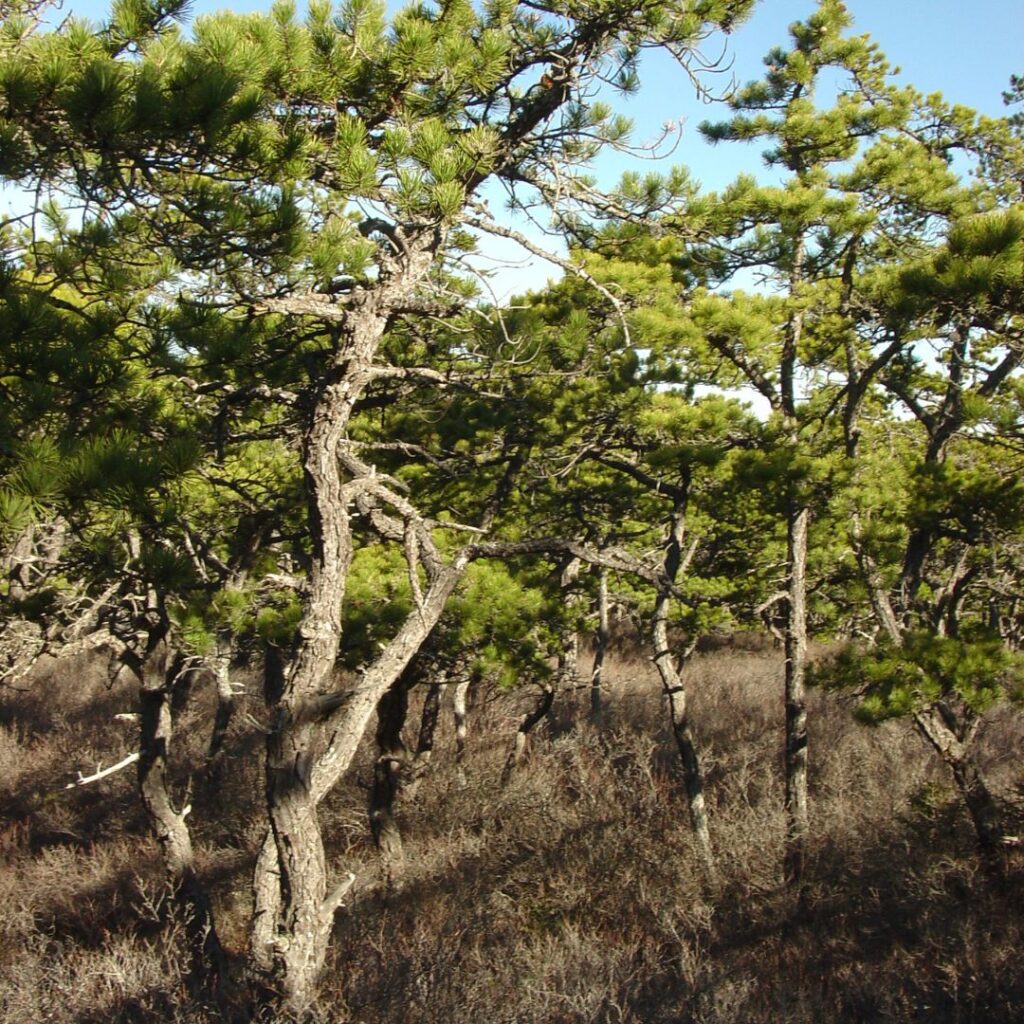
As the light dims, a flurry of moths drifts from the shrublands and forest alike with dark silhouettes of Big brown (Eptesicus fuscus) and Eastern red bats (Lasiurus borealis) often at their heels. Io (Automeris io) and Polyphemus moths (Antheraea polyphemus) could sometimes be seen fluttering past. Soon after, the first whip-poor-will songs would begin. At this, the signal emitted by the receiver would drop off and my search for the bird, now on his way to relieve his mate of her incubation or brooding duties, would start anew. In these environments, their nests are almost always located within the dense tangles of scrub oak. Switching on my headlamp and entering the thick vegetation, I follow the direction dictated by the signal strength emitted by the bird’s tag. Bee-lining through this environment is almost impossible, however, nests are seldom far from edges or openings.
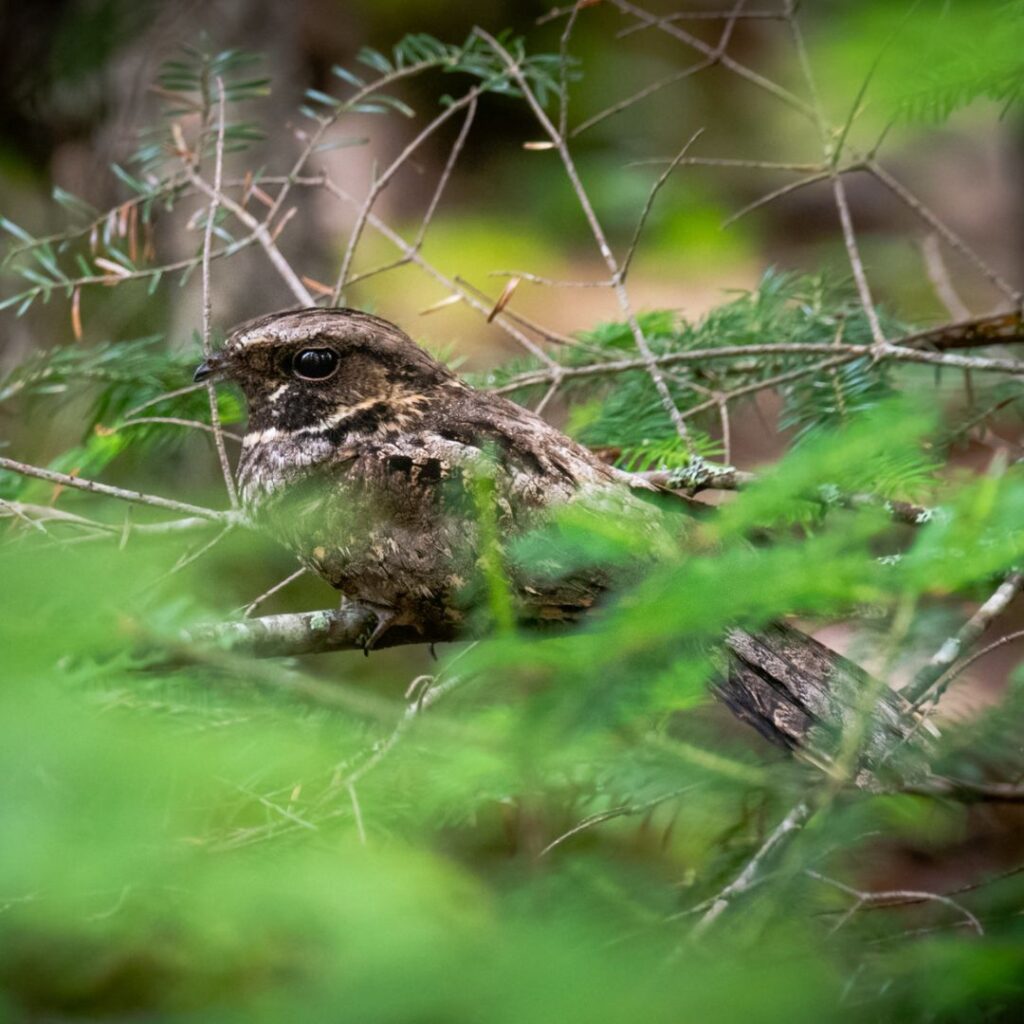
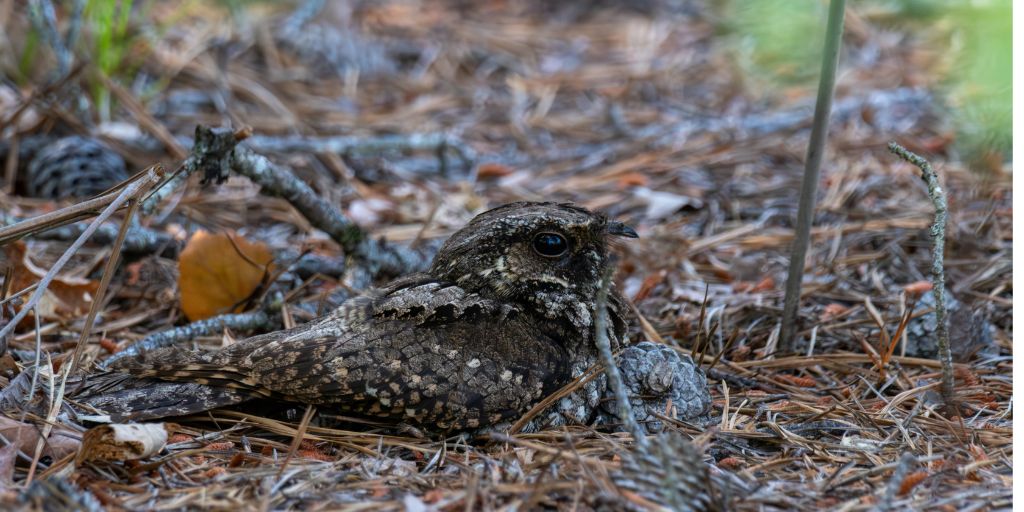
As the signal peaks, I spot the fiery glow reflected by the whip-poor-will’s eyes. He sits tight to conceal the location of his young, nearly invisible save for the eye shine. Maine’s nightjar species nest directly on the ground and do not construct nest structures. The well-drained, sandy soils of the barrens benefit these ground nesters by ensuring that eggs and nestlings aren’t flooded during rain events while the adult’s plumage is well-suited to match the ground and accumulated vegetative debris. Marking the spot in my GPS and installing an infrared camera to monitor the outcome of nesting efforts, I leave him to his work and back my way out of the scrub.
This project’s efforts to document the outcomes of nightjar breeding efforts has captured evidence of demonstrating the value of pitch pine – scrub oak barrens as nesting grounds. Instances of nest predation are quite rare in these environments with predation being documented on only two occasions over the last three years; once by an Eastern coyote and another time by a Blue Jay. More often than not, however, nests are passed by without detection. Over the years, we’ve documented coyotes, bobcats, deer, raccoons, skunks, fishers, crows, and wild turkeys all in relatively close proximity to nightjar nest locations. It seems that the dense vegetation paired with the bird’s cryptic plumage affords these pine barren nesters a significant degree of protection.
The shelter offered by these habitats is a benefit to other vulnerable species as well. Northern Black Racers (Coluber constrictus constrictus) are listed as endangered in Maine due to habitat loss and fragmentation. These long black snakes rely on the blend of habitats found in the state’s barrens for nesting sites, shelter, and hunting grounds. Although often associated with coastal shrublands and old fields, the distribution of another state-listed endangered species, the New England Cottontail (Sylvilagus transitionalis), overlaps with the occurrence of Maine’s largest pine barrens, a habitat type inhabited by the species elsewhere throughout their limited range. These cottontails, also known as “brush rabbits”, require large areas of thick vegetative cover to forage and avoid predators. Maine’s barrens may serve as suitable habitat areas as conservationists work to restore this vulnerable young forest specialist.
By day or by night, the barrens are alive in ways unseen by most: whip-poor-wills sheltered in bowers of scrub, hairsteaks and duskywings fluttering from one rare wildflower to the next, glossy black racers basking in patches of exposed sand left by glaciers in ages past. Although diminished from their historic extents, these are some of Maine’s most resilient wildlands: landscapes shaped by fire and ice, disruption and renewal. Yet they still require thoughtful stewardship. Rich in biodiversity, Maine’s barrens are a testament to the value of preserving even the rarest habitat types.
Related Content
-

Nightjar Monitoring
Maine’s Eastern Whip-poor-wills and Common Nighthawks have undergone significant declines in recent years and MNHO is partnering with Maine…
-
12/28/25: Maine’s Pine Barrens, part 1
In this episode, Logan introduces Maine’s rare pitch pine–scrub oak barrens, explaining how glacial sands, fire, and other disturbances…
-
1/4/26: Maine’s Pine Barrens, part 2
In this episode, Logan explores the plant communities of Maine’s pitch pine–scrub oak barrens, from fire-adapted pines and dense…