
Nature Notes: A Maine Naturalist Afield
Host: Logan Parker
Producer: Glen Mittelhauser
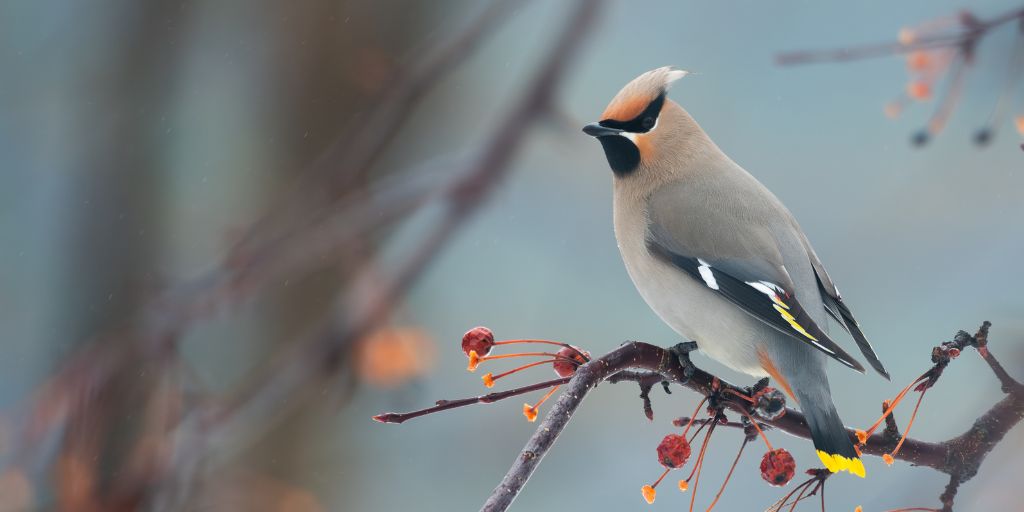
In this episode, Logan explores the winter irruption of Bohemian Waxwings into Maine, where flocks descend from boreal breeding grounds in search of lingering fruits such as crabapples and mountain ash. He describes their gregarious behavior, fruit-based courtship rituals, and surprising presence in towns and cities, reminding us that even in winter’s apparent scarcity, the landscape still holds abundance.
Transcript
For many of us in the Northeast, winter can be viewed as a period of absence. Days are short and nights are long. Most efforts to bask during the sun’s limited window of light require the rituals of bundling and subsequent thawing beside the woodstove. Outside our windows, the snow has hidden much of the landscape’s complex, interwoven tapestry beneath a more uniform and colorless blanket. Save for the conifers, the leafless forests appear gray, bare, and pensive. The hundreds of birds that rely upon these northern woodlands in green timers are reduced to a skeleton crew, composed of those birds hardy enough to contend with the cold and forgo the efforts of migration.
Strange as it would seem, these year-rounders often come to share the harsh winter world with a host of other birds that come to pass the season here. For the latter, our seemingly barren landscapes offer both refuge and a bounty of food sources. These birds include irruptive “winter finches” such as Redpolls, Siskins, Crossbills, as well as Evening and Pine Grosbeaks. These birds descend from their northern breeding grounds in search of tree and grass seeds. Other irrupting birds include predatory species like Snowy Owls, Rough-legged Hawks, and Northern Shrikes that rely mostly upon birds and rodents to sustain themselves through the winter.
While most winter irruptors survive on diets mostly associated with natural habitat features found within the northeast, one species stands out for its regular association with more ornamental sustenance. Bohemian Waxwings are distributed around the northern hemisphere. Within North America, these showy passerines breed within the open boreal woodlands of western Canada and Alaska. Although technically “songbirds” these birds are so gregarious and tolerant of their peers that they do not maintain territories or produce true songs. When nesting, Bohemian Waxwings are known to construct nests in close proximity to one another (Semenchuk, 1992).
During the summer months, waxwings eat diverse diets of plant foods and insect prey (Witmer, 2024). In winter, these birds rely largely upon fruits ripened over the summer and autumn. During years when these food sources are depleted, Bohemian Waxwings stage long range winter movements in pursuit of tree fruits. These include those of the mountain ash, cherry, and hawthorne, however, the tree species I most associate them with are apples. Almost all of my Bohemian Waxwing encounters have occurred standing next to ornamental or wild crabapples at points all throughout Maine. The pursuit of winter apples has led these birds to landscapes that differ greatly from their remote northern breeding grounds. Most of my Bohemian Waxwing observations have been made on the fringe of or within bustling cities, towns, and other developed areas. Just the other morning, I watched more than a hundred birds frequenting a crabapple beside a busy state road, the flock flushing for high vantages nearly each time a commuter passed. I can only imagine how exhausted a bird observed in an apple tree in Brooklyn’s Prospect Park in 2007 must have been.
The Northeast functions as more than just a larder for wintering waxwings. It can also be the stage on which courtship activities are performed. Though frequently in the company of dozens to hundreds of peers throughout the year, Bohemian Waxwings are believed to be monogamous. Pair formation often begins during the winter months with fruit featured heavily in ritual. Fruits are exchanged to potential mates and passed back and forth. Females will also flutter their wings to solicit feeding by the male, a behavior that mimics feeding nestlings in summertime (Witmer, 2024).
Waxwing winters are a reminder that, even in the scarcest of seasons, the fields and forests are rich with abundance as well as capable of sustaining and propagating life. This year is a waxwing winter and flocks are being reported from Presque Isle all the way down to York. All these sightings are proof that, at least to some, waxwings are worth bundling and thawing for.
Citations:
Semenchuk, G. P. (1992). The Atlas of Breeding Birds of Alberta. Federation of Alberta Naturalists, Edmonton, AB, Canada.
Witmer, M. C. (2024). Bohemian Waxwing (Bombycilla garrulus), version 1.1. In Birds of the World (S. M. Billerman, Editor). Cornell Lab of Ornithology, Ithaca, NY, USA. https://doi.org/10.2173/bow.bohwax.01.1
Related Episodes
-

12/1/24: Clock-work
Maine’s cuckoos are among the most secretive birds to breed within our woodlands. Here we explore their fascinating natural…
-
12/15/24: Jay Mimicry
Is that truly a hawk you hear? Learn the deceptive tactics jays employ to secure their share of the…
-
7/13/25: The Hunt for the Red-breasted Merganser, part 1
A noteworthy observation on Moosehead Lake sparks a determined effort to document one of Maine’s rarest breeding waterfowl.


