MNHO’s For the Birds fundraiser was a huge success!
Thank you so much to everyone who stepped up to help MNHO purchase equipment to research Maine birds this summer! Because of your incredible generosity, we exceeded our goal and will be able to purchase everything we need for a successful field season. Thank you!
We need your help to purchase equipment for two important bird research projects planned for the 2026 field season.
Although we have secured the minimum funding and equipment needed for these projects to move forward, additional equipment is needed to make the most of these research opportunities and make the biggest difference we can for Maine birds. Adding just a few trackers and trail cameras to the MNHO equipment library will significantly increase the amount of data we can collect in a single field season and allow us to more fully and efficiently understand the factors contributing to declines in these species.
Here is what’s going on:
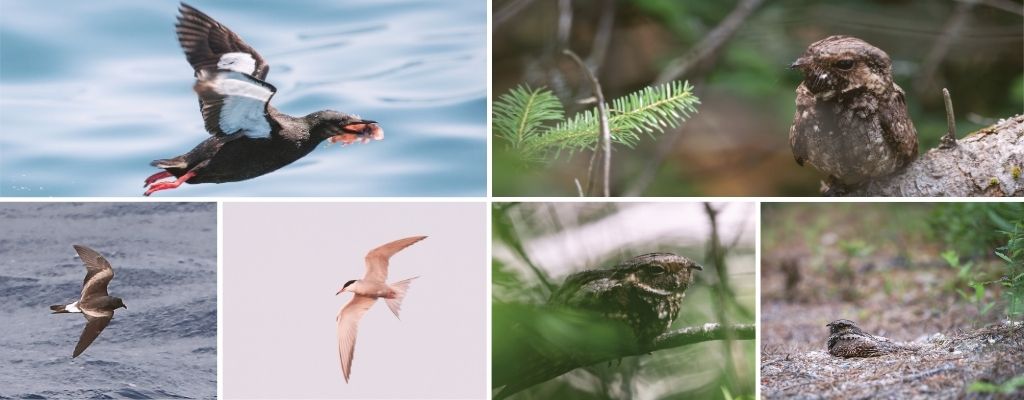
- Camera Tracking to Support Maine’s Coastal Seabirds and Waterbirds: Seabird biologists are increasingly concerned that growing mink and otter populations may be negatively affecting where seabirds can successfully nest along Maine’s coast. To better understand this, MNHO is starting a camera tracking project to document where and how frequently these mammals are present on islands. By strategically deploying trail cameras on both seabird nesting and non-nesting islands, we will examine how mink and otter move between islands and how their activity differs from islands close to the mainland to those farther offshore. The cameras we need cost $150 each, and we aim to purchase 25 units.
- Tracking the Annual Cycle of Eastern Whip-poor-wills: Eastern Whip-poor-wills have declined by more than 61% in the last 60 years, and tracking their movements remains one of the key gaps in understanding this decline. By attaching VHF nanotags and geolocators to birds already being studied, we can greatly improve our ability to map their migration timing, pathways, and, for the first time, wintering areas. We plan to purchase 12 VHF nanotags and 6 geolocators for this effort. Each nanotag costs $225 and each geolocator costs $250.
Our goal is to raise $7,950 by April 30th, with $3,750 supporting the coastal island camera tracking network and $4,200 supporting Whip-poor-will tracking equipment.
We know you understand how important careful, long-term research is for conserving Maine’s birds. If you are able, please send a contribution. Even a small gift helps ensure that this season’s field work reaches its full potential.
This project is designed to better understand how Maine’s coastal islands are used by mammals such as mink and otter, and what that means for birds that depend on these islands throughout the year. Seabird biologists are increasingly concerned that these mammals may be affecting the distribution and success of sensitive breeding seabirds, including species such as Leach’s Storm-Petrel, Common Tern, and Black Guillemot. By strategically deploying trail cameras on both nesting and non-nesting islands, we will document patterns of mammal presence, visitation rates, and movement between islands across a range of conditions, from islands close to the mainland to those farther offshore. Spearheaded by MNHO ecologist Elliot Johnston, this project will provide the first systematic assessment of how mink and otter are distributed across Maine’s island network, focusing on Penobscot Bay in this first year.
A leading authority on nightjar research in the Northeast, MNHO Ecologist Logan Parker launched the Maine Nightjar Monitoring Project in 2017 to better understand the causes behind long-term nightjar population declines. Using VHF nanotags (which report bird locations when they fly within 12 km of a receiver tower), we have successfully tracked the timing of migration and broad-scale movements of Eastern Whip-poor-wills through the Motus Wildlife Tracking System. These efforts have provided important insights, but key gaps remain in our understanding of how these birds move across the landscape and where they spend the winter. We are now building on this work by incorporating geolocator tags which use GPS technology to provide near-continuous, real-time coordinates. This technology will allow us to better understand migration pathways, stopover site use, and the locations of nonbreeding areas, including where these birds spend the winter in South America. Together, these tools will provide a much more complete picture of the species’ annual movements and habitat use. Any surplus funds raised will also support DNA metabarcoding work to better understand Whip-poor-will diet, providing additional insight into prey availability and ecological constraints affecting this species.
Explore membership benefits here
If you prefer, you can also mail a check to:
Maine Natural History Observatory, 317 Guzzle Rd, Gouldsboro, ME 04607.
(Please include your email address if possible)