Nature Notes: A Maine Naturalist Afield
Host: Logan Parker
Producer: Glen Mittelhauser
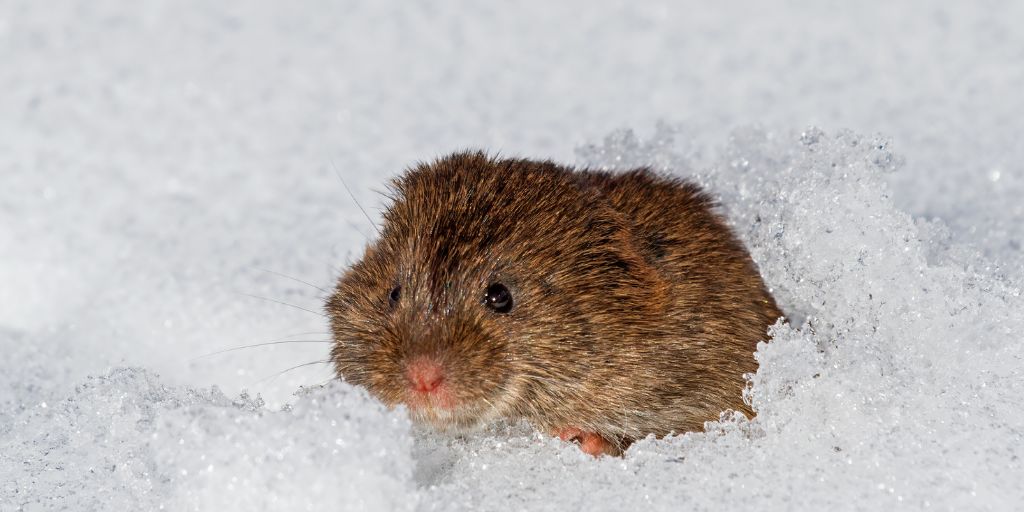
Logan explores the hidden world of Eastern Meadow Voles living within the subnivean zone beneath Maine’s winter snowpack. He describes their tunnel networks, grass-lined nests, and winter survival strategies, placing these small mammals within the broader ecology of predators, seed dispersal, and seasonal population cycles.
Transcript
By my reckoning, this is a “real” winter. Although relatively shallow, the snow has been a constant.
The little that melts or is blown away is regularly replenished. The wood stove has been in continuous use as most days the thermometer has hovered at or just below freezing. We did recently have a short spell warm enough to reduce the snow cover to just an inch or so above the ground surface. This temporary reduction revealed just how much activity has transpired without our notice in the clearing around our home.
Within the snow, a faint, gray network of tunnels sprawls in every direction. This crisscrossing series
of passages marks the comings and goings of Eastern Meadow Voles through the subnivean zone. This layer of the snowpack provides many benefits to the voles. Insulated by the snow and close to the ground, this relatively temperature stable layer permits the voles to travel throughout the thatched carpet of decaying grasses and herbaceous plants to gather food. Meadow voles have been known to strip the bark from small woody plants to reach the cambium layer, with girdled plants revealed by the retreat of snow in spring (Sullivan 2006). Although sharp eared predators including foxes and coyotes can still hear the rodents moving beneath the snow, the snowpack affords some protective cover for these dark furred rodents as they navigate a predominantly white landscape.
Rodents have adapted a number of means of winter survival. Chipmunks are known to enter torpor, temporary periods of reduced activity and lower body temperatures to reserve their energy, emerging only on the warmest days. Woodchucks are true hibernators, passing the winter in burrows beneath the frost line in a state of suspended animation. Although mice are capable of entering short intervals of torpor during periods of scarcity, their willingness to cohabitate with humans has led many mice out of the cold and into the warmth of our homes. Voles remain active through the winter, but rarely enter houses. Contending with the season’s challenges requires meadow voles to forage frequently and to construct sheltered places to rest and reserve their energy.
I have found a handful of vole nests over the years, mostly by accident when overturning a scrap of lumber or rolling a log aside. In some springs, I’ve found the damp remains of nests in open areas nestled within the labyrinth of tunnels. Composed of fine, interwoven grasses, these shaggy, spherical shelters offer wintering voles added insulation beneath the snow, further reducing heat loss. Although voles produce several litters of young throughout the year, territorial and breeding behaviors are reduced at the height of winter. Pairs and sometimes small groups of voles will sometimes huddle together in nests to keep warm (Madison et al. 1984; Robitaille et al. 1990). These winter homes are a liability during warm spells, as the tufts of dry grasses and other plant matter easily wick water from the melting snow and absorb winter rains. Damp, exposed nests will quickly freeze as temperatures fall. Winter is the most deadly period in the relatively short lives of the meadow voles. Populations fall to their lowest levels in the lead up to spring (Johnson and Johnson, 1982). Mild, snowless winters are particularly dangerous for voles, exposing them to the elements and greater risk of predation by raptors. While meadow voles are often regarded as a pest by farmers, gardeners, and orchardists due to their crop damage, these small mammals do play important roles within the landscape, dispersing seeds and serving as an important food source for a wide array of predators (Sullivan et al. 1999).
Fortunately for our resident voles, those recently exposed tunnels are now beneath 5” of fresh, powdery snow. The 7-day forecast is calling for more snow throughout the week before a mass of
frigid air blows in from the northwest. Temperatures are expected to fall well below freezing. While our raised beds have been pilfered by voles a time or two, I am glad to know that our clearing’s meadow voles will be safe within the subnivean zone when the winds are whipping… though do I hope they keep their teeth off the Chokeberries we planted this spring.
Citations:
Johnson, M. L. and S. Johnson (1982). “Voles: Microtus species”. In Chapman, Joseph A.; Feldhamer, George A. (eds.). Wild mammals of North America: Biology, management, and economics. Baltimore, MD: The Johns Hopkins University Press. pp. 326–54.
Madison, D. M., R. W. FitzGerald., & W. J. McShea (1984). Dynamics of social nesting in overwintering meadow voles (Microtus pennsylvanicus): possible consequences for population cycling. Behavioral Ecology and Sociobiology, 15(1), 9-17.
Robitaille, R. L., & Courtin, G. M. (1990). Morphological and Thermal Characteristics of Winter Nests of the Meadow Vole, Microtus Pennsylvanicus. Eastern c, 231.
Sullivan, T. P., R. A. Lautenschlager, and R. G. Wagner (1999). “Clearcutting and burning of northern spruce-fir forests: implications for small mammal communities”. Journal of Applied Ecology. 36 (3): 327–344.
Sullivan, T. (2006). Vole populations, tree fruit orchards, and living mulches. Center for Sustaining Agriculture and Natural Resources. Washington State University. http://organic.tfrec.wsu. edu/OrganicIFP/OrchardFloorManagement/oles_Orchards_Mulches_Report_2006. pdf.
Related Episodes
-

-
3/16/25: Wet Flats in Winter
Learn about the ecoregion known as the Upper Saint John Wet Flats with Logan Parker.
-
4/13/25: Brown Brook Thaw
This piece is a reflection on the ecological stirrings of early spring, centered on the thaw and renewal of…